Pembrokeshire day one – 7th Oct 2011
Day one itinerary
Assemble at Splash Car Park 0845, leave 0900.
Arrive at National Museum of Wales 1100
Half group take conducted tour of Exhibition “The Evolution of Wales”, whilst
the other half group have a conducted tour of the research of the Geology
Department.
Lunch at own expense at the Museum Restaurant or coffee shop.
Half groups swap activities.
Leave Museum 1500.
Arrive Park hotel Tenby by 1700.
Lecture by John Payne at 1800, on the Geological History of Pembrokeshire,
prior to Dinner .
Write up of day one by April Gilbert
Friday 7th October found us on our way to Tenby for a long weekend looking at the geology of Wales. We called in at the National Museum of Wales in Cardiff.
On arrival we were given two excellent talks, one by Dr Jana Horak about the dating of rocks and one by Dr Caroline Buttler about the various fossils that they hold in their collection; sea creatures, plants, trees, footprints and reptiles.
Later we were taken to the preparation labs where rocks are cut and sliced then fixed to microscope slides for further study. We also saw how the internal structure of a rock is examined by non-destructive X-Ray diffraction. This is essentially fingerprinting by comparison of spectra (patterns) with those of reference specimens. The technique provides a semi-quantitative analysis of elements and minerals present and can also distinguish between polymorphs.
In 1907 the department received a donation of a large number of rock specimens from a collection personally made by the Countess of Powis. Also found at a later date her notebook, which gave all the information on how the collection was made and where.
In the afternoon we looked at the exhibition entitled “The Evolution of Wales”. This was excellent and showed how the earth was formed. It used videos to demonstrate how volcanoes and earthquakes evolved, also a large map showing the main areas in the world where these occurred.
A large collection of fossils were shown and skeletons of animals and fish, also a number of stuffed animals to represent the evolution of the species. Included too were flint tools.
This is a large exhibition and was very well put together. Well worth a visit. Unfortunately a written guide to the specimens on display and the exhibition wasn’t available.
April Gilbert, with input from Stuart Robinson
Pictures from day one
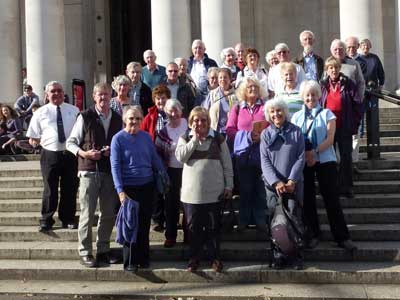
The group at the entrance to National Museum of Wales.
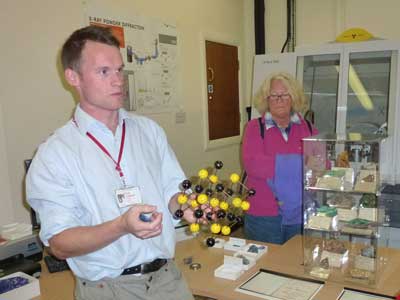
Explaining the principles of X-ray diffraction.
Some of the Countess of Powis’ rock connection are in the background.
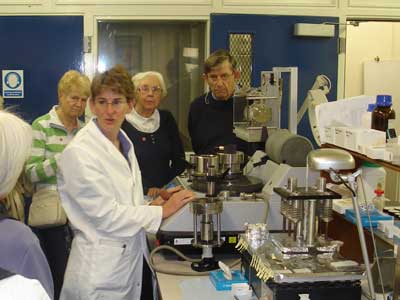
Cutting and slicing rocks for further study.
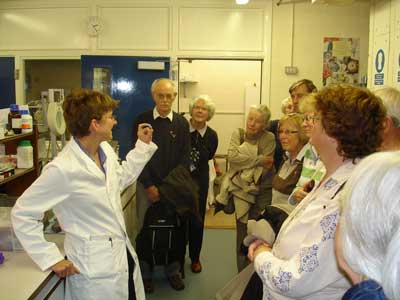
A rock sample after preparation.
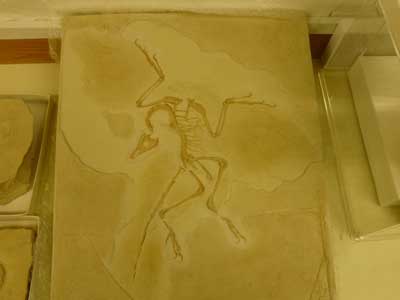
Archaeopteryx fossil, from the museums extensive collection.